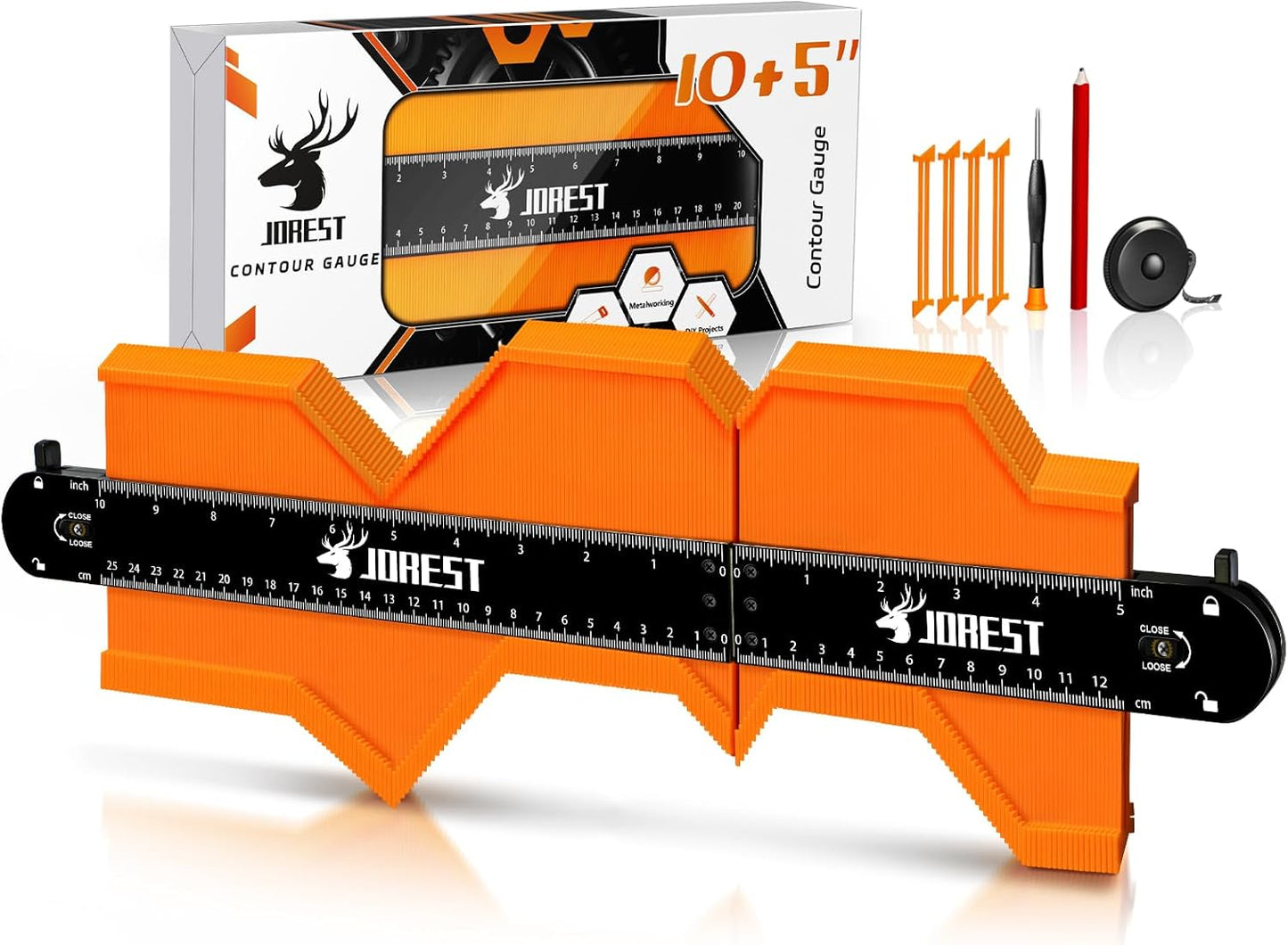
JOREST Connectable Contour Gauge (10+5 Inch) – Sleek Profile Tool for Installing Baseboards, Crown Molding, and Decorative Trim
JOREST Connectable Contour Gauge (10+5 Inch) – Sleek Profile Tool for Installing Baseboards, Crown Molding, and Decorative Trim
Couldn't load pickup availability
Why you'll love it
- Three-in-one sizing (5", 10", 15") via connectable gauges eliminates the need to buy multiple tools
- Ultra-thin 0.05" blade and tight 0.06" protractor spacing deliver accurate profile reproduction
- Lock mechanism holds the copied shape in place so both hands stay free for cutting
- Adjustable blade tension lets users fine-tune tightness for consistent tracing
- Works with a wide range of trades and DIY tasks from tiling to welding to wallpaper
Perfect for
- Trace and duplicate irregular shapes for tile and laminate flooring installation
- Scribe molding, baseboards, and trim against uneven walls
- Copy pipe contours and odd angles for woodworking joinery
- Cut vinyl plank, LVP, or carpet to fit around doorways and corners
- Gift a practical tool for Father's Day, Christmas, birthday, or anniversary


Product Information
【Three Sizes】The 5-inch and 10-inch contour gauges can be spliced together so that you have three sizes of gauges - 5-inch, 10-inch, and 15-inch. 5-inch is perfect for tight spaces; 10-inch suits for most objects; and 15-inch is for larger objects. 【Multi Purpose】Being used with other tools such as pallet buster, crowbar, bradawl, carpentry tools, marking tools, leveler tool, oscillating tool, caulking tool, floor/baseboard cutter and so on. Be it vinyl tiles laying, tiling, hardwood/lvp/laminate flooring, carpet cutting, wallpapering, wall panelling, home improvement, wood working, winding pipes, moulding, welding, DIY, the JOREST contour gauge comes in handy while profiling work. 【Well-designed】1. the double-sided scale of the tracer is in inches and centimeters; 2. the thickness of the blade is only 0.05 inches, which makes the measurements accurate; 3. the protractor spacing is less than 0.06 inches after splicing; 4. the blade looseness and tightness can be adjusted with a screwdriver. 【Easy to use】You simply press the copied shape onto the material to be cut, then trim the contour. Odd shapes is also to be traced. This angle finder is a good helper for DIY handyman, craftsmen, woodworking workers, carpenters, construction architects, designers. 【Holiday Gift Guide】Have you ever seen a more versatile and unusual gift ideas? You can try out this unique cool gadget as the present for men/women who have everything while Christmas, Birthday, Anniversary, Father's Day.
Manufacturer JOREST Part Number AJJOCG0101ORDUS1 Item Weight 1.83 pounds Package Dimensions 12.83 x 5.59 x 1.89 inches Item model number AJJOCG0101ORDUS1 Size 15 Inch Style 15 Inch Package Item Package Quantity 1 Batteries Included? No Batteries Required? No
Frequently Asked Questions
Can this gauge help me install baseboards that sit flush against wavy walls?
Yes. Press the gauge against the wall corner, lock the pins, and transfer that exact wave to your baseboard for a scribe cut that hugs the wall cleanly.
Is it good for decorative trim like crown molding and chair rails?
Yes. The 15 inch connected size is long enough for sweeping crown profiles, and the 0.05 inch thin blade captures fine curves in period style trim work.
Will it help with wallpaper that needs to fit around outlets and corners?
Yes. You can capture the contour of light switches, window casings, and inside corners, then transfer that profile to your wallpaper before cutting.
Can I use it for wainscoting and paneling projects?
Yes. The 10 inch and 15 inch configurations capture the long, gentle profiles typical of wainscoting caps, panel edges, and chair rail returns.
Does it help when fitting flooring around decorative tile patterns?
Yes. The thin blade slips along curved mosaics, hex tiles, and pattern borders so laminate or vinyl planks can be cut to follow the design accurately.
Can I use it to scribe a new mantel to an uneven fireplace surround?
Yes. Hold the gauge against the stone or brick face, lock the contour, and use that profile to cut the mantel to sit tight against the wall.
Does it work for built in shelving and alcove units?
Yes. The 15 inch connected length captures the long wavy walls of older homes, which is critical for built ins that need to look seamless.
Is the tool discreet enough to leave on a decorator's workbench?
Yes. The slim steel body and neutral finish look at home next to design materials like fabric swatches, tile samples, and wood blocks.
Can I use it for staircase renovation and stair rod fitting?
Yes. The gauge captures the uneven angles where treads meet skirt boards, which is one of the most common trim challenges in a stairwell refresh.
Will it help me cut flooring around a decorative hearth or rug edge?
Yes. Press the gauge along the curved edge of a hearth or a custom rug outline, then transfer that profile to laminate or vinyl plank for a clean fit.
Does the locking mechanism help with long decorative cuts?
Yes. Locking the profile lets you walk to a long board and scribe across its full length without the pins drifting, which matters for long crown or chair rail work.
Can it capture the shape of a curved archway for trim installation?
Yes. The 15 inch connected configuration is long enough to follow the curve of a standard archway, and the lock holds the contour during transfer.
Will it help me install a decorative tile border in a bathroom?
Yes. You can capture the contour of a vanity base, a curved mirror, or a freestanding tub edge, and cut border tiles to follow those shapes.
Is it useful for laying out accent wall slats or shiplap?
Yes. The gauge captures ceiling and floor irregularities so the first and last boards of an accent wall can be ripped to a custom taper for a tight look.
Does the inch and centimeter scale help with imported tile sizes?
Yes. Many decorative tiles are sized in metric, and the dual scale lets you read the layout directly without converting from millimeters.
Will the tool leave a clean, designer grade finish when used correctly?
Yes. Because the profile is captured exactly, your cuts follow the real wall or floor rather than an estimated line, which is what gives high end installations their tight seams.
How do I use the JOREST contour gauge step by step?
Press the steel pins firmly against the object you want to copy, slide the lock to hold the shape, place the gauge on your workpiece, and trace along the locked pins with a pencil or knife to transfer the profile.
How do I connect the 5 inch and 10 inch gauges into a 15 inch gauge?
Line up the connecting tabs at the end of each gauge and slide them together until they click and seat flush, then use the combined length for longer profiles like crown molding and baseboard runs.
How do I adjust the blade tightness?
Use a small Phillips screwdriver to turn the tension screw on the gauge body. Tighten for stiffer pin movement on rough materials and loosen for smoother movement on delicate vinyl or laminate.
Does this work with vinyl plank, LVP, laminate, and carpet?
Yes. The thin 0.05 inch blade slips against most flooring materials including luxury vinyl plank, laminate, engineered hardwood, and carpet backing for doorway and corner cuts.
Will it capture profiles on tile, stone, and concrete surfaces?
Yes. Press the gauge firmly against tile edges, stone transitions, and concrete curbs, and the steel pins will register the shape for accurate flooring and trim cuts.
What is included in the box?
You receive the contour gauge in the size you ordered, either the 10 inch standalone version or the 10 plus 5 inch combo. No batteries, glue, or extra accessories are required.
Is this tool safe to use around children and pets?
The steel pins are smooth and blunted, and the locking mechanism has no sharp moving parts, so it is safe to store on a low shelf or in a family workshop with normal supervision.
How should I clean and store the contour gauge?
Wipe the pins with a dry cloth after use, occasionally apply a light machine oil to the pivot, and store the gauge flat in a drawer or hung on a pegboard hook to keep the pins aligned.
What is the difference between a contour gauge and a profile gauge?
They are the same category of tool. Both capture and transfer irregular shapes, and the JOREST version adds a lock, adjustable tension, and a connectable design that many basic profile gauges lack.